

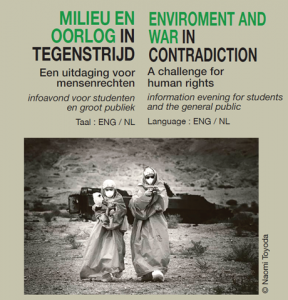
Though humanity has always counted its war casualties in terms of dead and wounded soldiers and civilians, destroyed cities and livelihoods, the environment has often remained the unpublicized victim of war. Waters have been polluted, crops torched, forests cut down, soils and air poisoned, and animals killed to gain military advantage.
The UN General Assembly declared 6 November of each year as the International Day for Preventing the Exploitation of the Environment in War and Armed Conflict (A/RES/56/4).
Prior to this International Day, ICBUW speakers and experts were invited by KU Leuven University, Belgium, and the Leuven Peace Movement to provide information to students at the Faculty of Law-Criminology on “Environment and War as a Challenge for Human Rights.”
Ecological awareness of warfare started after the war in Vietnam and the use of Agent Orange. From the 1970s, the law of war included environmental clauses, but conditions and terms remained vaguely defined. Meanwhile, developments went further to broaden environmental protection in times of war and to involve UN bodies in the issue. Still, there are loopholes, but also positive developments, such as the emergence of a human right to clean, healthy and sustainable development.
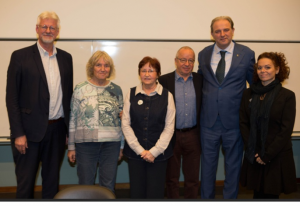
Left to right: Prof. S. Parmentier – Dr. A. Claussen – R. Verjauw – Prof. M. Mohr – Dr. S. Aleksic – S. Divertito
Prof. Manfred Mohr, International lawyer and ICBUW co-chair, explained the advantages of amultifaceted legal approach to protecting the environment in armed conflict. This encompasses International Humanitarian Law (IHL), Human Rights, Environmental, and International Criminal Law. While the (originally) high IHL thresholds have evolved into a general “duty of care” relating to environmental protection, human rights and environmental law standards are applicable in times of war as well.
The International Law Commission of the United Nations (ILC) formulated Draft Principles on the Environment in Relation to Armed Conflict (PERAC), No. 26 of which deals with (toxic) remnants of war, such as depleted uranium. Altogether, the focus shifts to post-conflict scenarios, victim assistance, and environmental remediation. Here, international human rights implementation schemes come into play.
Simon Sterck, student researcher, Master in Law, KU Leuven, highlighted positive developments by scholars, such as reform proposals within the Additional Protocol I to the Geneva Conventions, drafting a new environmental protection protocol, and organizing a global conference to define the environmental harm caused by war. A panel of experts can provide clear definitions and integrate the Precautionary Principle.
The chances are real that military powers will try to dominate these processes again. Persistence in all our actions is therefore needed.
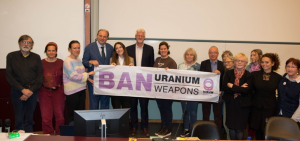
The team of ICBUW experts, KU Leuven and Leuven Peace Movement
Dr. Srdan and Olga Aleksic spoke passionately about the Serbian Karisik case they worked on. It is the first case in domestic judicial practice in which a Serbian citizen succeeded in proving that his illness was a consequence of exposure to depleted uranium during his service in the Yugoslav Army, and that the Republic of Serbia is responsible because it did not protect the victim. The results of the tissue analysis were key pieces of evidence. Science became the foundation of legal proof.
The Karisik case is of international importance and offers possibilities for similar proceedings in other states to help compensate and recognize DU victims and their families. The right to health and life must remain above all.
Dr. Angelik Claussen, vice-president of European IPPNW, focused on the health effects of depleted uranium weapons and on protecting civilians from exposure. There are five key steps to limit civilian exposure: assessment, marking, awareness raising, cleanup, and monitoring. However, data on contaminated sites are mostly not released by the users of DU weapons. More research on the long-term consequences of DU exposure is needed.
Many obstacles hinder long-term studies, such as a lack of data on contaminated areas, the impossibility of complete cleanup operations, migration of local populations during wartime, and post-war priorities. Finally, NATO claims immunity for the consequences of its military operations within domestic legal proceedings. Bridging the gap between the protection of local civilians and military personnel remains a challenge for both national and international law enforcement.
Stefania Divertito, investigative journalist and expert on “Climate and Weapons Testing in Sardinia,” presented an unforgettable documentary on how Sardinia became a radioactive and chemically toxic nightmare due to military pollution and environmental damage. Even during peacetime, military activities and weapons testing cause damage and pollute the environment. Europe’s second-largest firing ranges are situated in Sardinia, used by the Italian Armed Forces, NATO countries, Israel, and others.
The local population and their livestock suffer from several diseases and birth defects. Hiding behind military secrecy is unacceptable and violates human rights.
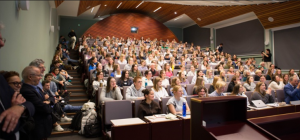
3rd-year students of criminology and law
Final conclusions were presented by Ria Verjauw, ICBUW co-chair.
War does not end with peace treaties – pollution caused by weapons remains in the environment for a very long time. During this information event, we focused on one type of weapon: depleted uranium weapons, and the consequences of their use.
While no explicit global ban on DU weapons exists yet, the legal framework surrounding international humanitarian law, environmental law, and human rights law makes the use of DU weapons illegal. Their long-term harm to both human populations and the environment underscores the necessity of a full international prohibition.
All speakers agreed that civilians and the environment need to be protected, and that DU weapons must be banned worldwide. There is a need for an international convention banning DU weapons, as well as a global registry of contaminated zones and a support system for victims.
We all should work towards sustainable peace and the prevention of armed conflict – and not “green” war. Awareness raising remains one of our important tasks because the military’s contribution to pollution and climate change is still underestimated and unknown to the general public. Working together to establish a legal framework to protect the environment and promote peace is essential. We reject war as a means of conflict resolution. War always entails the destruction of the environment and human life.
4 November – morning seminar
 We were invited by Prof. Stephan Parmentier to a seminar on “The Research Line on Human Rights and Transitional Justice.” Formally established in 2016, the Fund encourages and develops research and activities on transitional justice in (post-)conflict situations, mostly but not exclusively in the Global South, with the long-term aim of promoting sustainable justice, peace, and development. Particular attention is devoted to models of reparative and restorative justice that focus on harm reduction for victims and other stakeholders, as well as the (re)construction of conflict-ridden societies.
The seminar examined the legal qualifications of harms caused and explored ways to protect the environment and the climate. A lively exchange of thoughts, expertise, and future aspirations made the seminar unforgettable and inspiring.
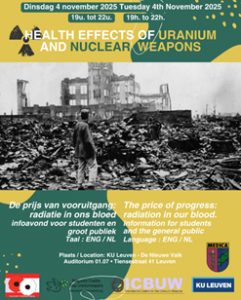
4 November – info session for MEDICA students
The evening event on 4 November was organized by the student association Medica of KU Leuven. The movie Toxic NATO by Moritz Enders was well received and sparked discussion and questions after the screening. Dr. Angelika Claussen and Stefania Divertito elaborated on the medical consequences of contamination by depleted uranium weapons, both on the battlefield and in testing ranges.
Our sincere thanks go to KU Leuven, especially Prof. Stephan Parmentier, Leuven Institute of Criminology, for giving us the opportunity to inform and motivate his students. This subject had previously been a gap in the students’ curriculum.
We hope these students will contribute in the near future to a more livable world, with respect for the environment and human rights, as taught at KU Leuven.
Ria Verjauw – ICBUW
 Diese Webseite benutzt Cookies. Wenn Sie unsere Webseite weiter nutzen, gehen wir von Ihrem Einverständnis aus.
 Our website uses cookies. If you continue to use our website, we assume your consent.