

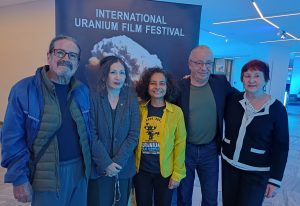
It all began with the opening event of the 10th International Uranium Film Festival (IUFF) in Berlin. It took place on the evening of 7 October at the wonderful venue of the Zeiss-Großplanetarium and set a positive atmosphere for the days to come. The highly impressive film Silent Fallout was screened as a joint project of the festival’s partner organisations (ICBUW, IALANA, IPPNW, ICAN, Sayonara Nukes, and the Peace Bell Society). It was shown again on 9 October, this time accompanied by an expert panel.
For the ICBUW group, the programme continued on 8 October with a boat trip along the Spree River in central Berlin. It served to deepen personal connections and, in addition to conviviality, led to the first substantive discussions. In the evening, the film „Toxic NATO“ was shown, accompanied by a book presentation by Srdjan Aleksic on Uranium 238. Das Krebs Geschoss. The well-attended event addressed, among others, the following questions:
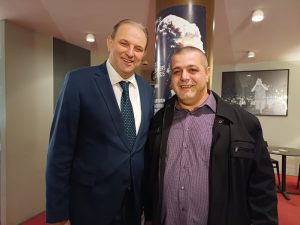
- The situation in Serbia (environmental conditions; the behaviour of society and government; the DU-related court case of Pančevo);
- DU-contaminated areas (Croatia and others);
- DU deployment decisions (NATO; awareness of risks);
- The role of the media;
- The situation in Romania (report of veteran/activist Dragos Nicolae).
9 October began with an intensive working meeting at the ICBUW/IALANA office in Marienstraße 19/20. Task distributions and next steps/projects were discussed – for example on the UN system, networking, Ukraine, and human rights protection procedures. A highlight of the day was the ICBUW workshop Banning Uranium Weapons – Assistance for Victims [link to article]. Following an introduction by ICBUW Co-Chair Manfred M., presentations were given on the Vacca case in Italy, the Karisik case, and the case of Dragos Nicolae Ghita.
Mr. Srdan Aleksić presented the landmark Karisik case, the first Serbian judgment to formally recognize a causal link between a citizen’s illness and exposure to depleted uranium (DU) during the 1999 NATO bombing. He explained how the plaintiff, a former soldier deployed in Pančevo without any protective equipment, developed lung cancer after operating in heavily contaminated areas. Crucial evidence came from an Italian laboratory, which detected DU particles in the tumor tissue, enabling the court to move from assumptions to material proof. The court ruled that Serbia had failed to take even basic protective measures for its forces and population, rejected the statute of limitations argument, and awarded compensation. The case has significant legal, political, and symbolic value: it demonstrates that causality can be proven through scientific analysis, confirms state responsibility for failure to protect, and offers a precedent for similar cases in other countries.
Ms. Carmen Marino presented the Vacca case, one of Italy’s most significant DU-related judgments. She recounted the story of Salvatore Vacca, a 23-year-old soldier who served in Bosnia in areas contaminated by DU, without adequate information or protective measures. He developed acute leukemia shortly after returning home. In 2016, the Rome Court of Appeals held the Ministry of Defense responsible for failing to assess and mitigate known health risks and established a causal link between his illness and DU exposure, even under scientific uncertainty. The court granted €1.8 million in compensation—the highest amount awarded in such cases in Italy. Ms. Marino emphasized the broader implications: hundreds of Italian soldiers have been affected, systemic delays persist in implementing court decisions, and the case reinforced the application of the precautionary principle. She also outlined the legal remedies available to families, including compensation, welfare benefits, and “victim of duty” recognition.
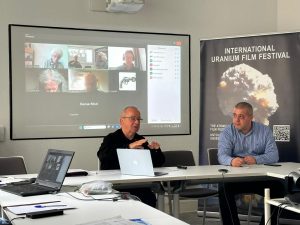
Mr. Dragos Nicolae Ghiță offered a powerful personal testimony, describing his journey from unexplained heart attacks to the diagnosis of a rare hematological condition linked to long-term exposure to toxic and radioactive substances. As a Romanian NCO deployed in Iraq and Afghanistan, he operated in areas heavily contaminated with DU. Facing institutional denial at home, he pursued independent medical analyses, which confirmed the presence of uranium and multiple heavy metals in his body. Despite official resistance, he continues to advocate for recognition of service-related illnesses and has launched petitions at national and EU level. He highlighted the importance of international solidarity, thanking experts, lawyers, and organizations—including ICBUW—for their support. His message underscored that many veterans across Europe may be suffering without answers, and that DU contamination is a cross-border humanitarian and political issue requiring coordinated action.
The contributions highlighted common aspects regarding state responsibility, DU-related challenges, as well as causality for those affected and their claims. Co-Chair Ria V. offered a summary and proposals for the way forward, focusing on the establishment of an international consultation and assistance mechanism for DU victims.
10 October was dedicated – at the Kino in der Königsstadt – to the life and work of our activist Damacio A. Lopez from New Mexico. He presented his newly published book My Last Battle: Ban Uranium Weapons, in which he describes his tireless commitment to this cause in a deeply personal way. It is thanks to him – together with Ria – that ICBUW exists at all. It was extremely moving to witness Damacio receiving the IUFF Lifetime Achievement Award from Marcia Gomes de Oliveira [link to IUFF Berlin 2025 Final | International Uranium Film Festival].
The IUFF closing ceremony on 11 October, again at the Großplanetarium, was attended by both Co-Chairs. Two harrowing films on the atomic bombings of Hiroshima and Nagasaki were shown, acts that already at the time constituted the gravest violations of international law. Against this backdrop and in light of the entire week in October, it is clear that the film work (in Berlin and elsewhere) and the engagement of ICBUW will continue. New momentum and new ideas have emerged. This was already evident at the immediately following events in Leuven on 3–4 November, organised largely by Ria. For 2026, a DU film and discussion event is planned in Sardinia…
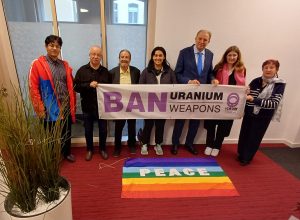
Manfred Mohr – ICBUW co-chair
 Diese Webseite benutzt Cookies. Wenn Sie unsere Webseite weiter nutzen, gehen wir von Ihrem Einverständnis aus.
 Our website uses cookies. If you continue to use our website, we assume your consent.